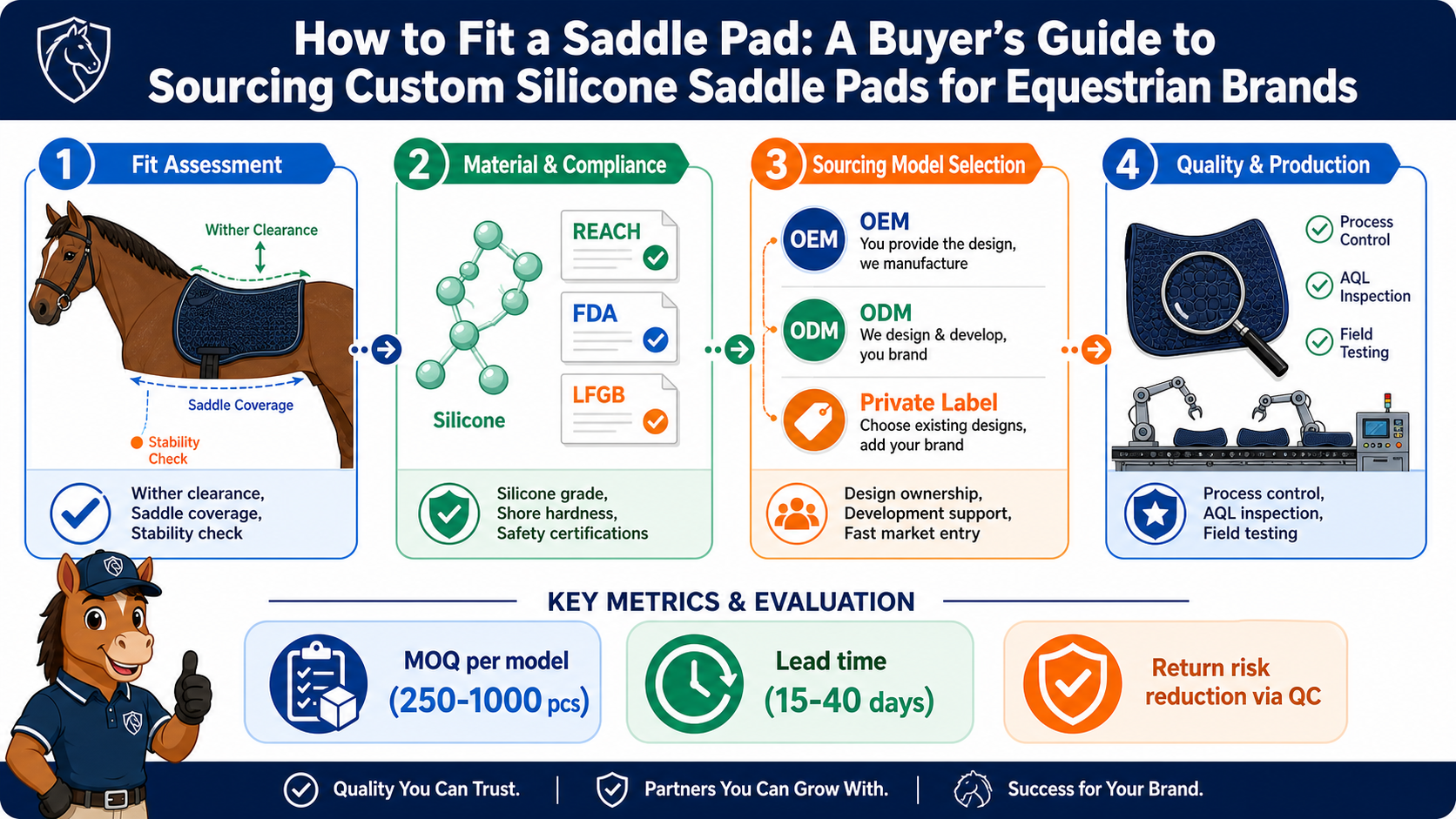
Knowing how to fit a saddle pad is important for horse comfort, rider safety, and product returns. A poor fit can cause slipping, rubbing, heat build-up, and pressure points. For equestrian brands, the issue is bigger than one horse. Your saddle pad must work across sizes, riding levels, weather, and stable routines. This guide explains how to judge saddle pad fit and how to source custom silicone saddle pads for the European market. You can also explore related product options on the Silicon Chain product list.
This guide will answer critical questions like how should a saddle pad sit under the saddle, what materials are best for low-maintenance horse tack, and what should buyers check before choosing a silicone saddle pad manufacturer. It also explains how OEM, ODM, and private label sourcing work for brands that want to launch or improve a saddle pad line. If you need custom material design, molding, and production support, the custom silicone rubber products service is a useful starting point.
How to Fit a Saddle Pad Correctly Before You Source One
A saddle pad should support the saddle without changing the saddle fit. It should not be used to hide a poor saddle fit. The pad should sit straight on the horse’s back. It should follow the topline without pressing hard on the withers. The front edge should show enough clearance under the saddle. The back edge should extend beyond the saddle panels, but not so far that it moves or folds.
For buyers, this means fit must be tested in real riding conditions. Do not only check the pad on a table. Place it on horses with different back shapes. Add the saddle. Tighten the girth. Then check the pad after walk, trot, canter, and jumping work if that is your target use. A good pad should stay stable. It should not bunch up, twist, or pull down over the withers.
Silicone saddle pads add another point to check. The grip surface must hold the saddle in place without feeling sticky or harsh. Silicon Chain designs silicone tack for real use scenes, such as daily riding, competition, stable care, and riding schools. This helps brands choose the right hardness, thickness, sewing method, and package style for each customer group.
| Fit Area | What to Check | Buyer Risk if Ignored | Custom Silicone Design Point |
|---|---|---|---|
| Wither clearance | The pad should not press down on the withers. | Rubbing, soreness, and poor horse acceptance. | Use shaped profiles and stable silicone foam support. |
| Saddle coverage | The pad should extend beyond the saddle panels. | Panel edges may contact the horse directly. | Set size systems from pony to large horse use. |
| Stability | The pad should not slide during turns or jumping. | Safety concerns and higher product returns. | Add silicone grip ribs for competition or training pads. |
| Cleaning | Sweat, hair, and dust should rinse away fast. | Odor, hygiene risk, and slow stable routines. | Use non-porous food-grade silicone surfaces. |
| Durability | The pad should recover after pulling and pressure. | Early failure in riding schools and clubs. | Choose tested silicone grades and controlled molding. |
Why Silicone Saddle Pads Are Different from Traditional Pads
Traditional saddle pads often use cotton, felt, wool, leather parts, or synthetic fabric. These materials can work well, but they may absorb sweat and odor. They can also need long drying time. In high-use barns, this becomes a daily cost. Staff must clean, dry, rotate, and store more pads. If pads stay damp, hygiene problems grow. If grit stays inside the material, the horse may face repeated rubbing.
Silicone is different because it is non-porous. In simple words, it does not have tiny holes that easily hold sweat, bacteria, and smell. Silicon Chain uses food-grade silicone for horse tack products. The material is designed to rinse clean with water. In daily riding use, silicone tack can be washed in about 30 seconds. The material can dry after wiping in about 3 minutes. This is a strong advantage for riding schools, clubs, and retailers serving busy owners.
Silicone also supports grip and shock control. Silicon Chain states that its saddle pad and girth combination can resist 35 kg of lateral shear force without shifting. This matters in competition and training, where fast turns and repeated rounds place more stress on tack. For brands, the value is clear. A silicone saddle pad can be sold not only as a comfort product, but also as a low-maintenance stable solution.
Material and Compliance Checks for Custom Silicone Saddle Pads
When sourcing custom silicone saddle pads, do not treat material as a small detail. It affects comfort, cleaning, safety, and market access. Ask the factory to explain the silicone grade, Shore hardness, tensile strength, and foam density if foam is used. Shore hardness means how soft or firm the silicone feels. A lower number feels softer. A higher number feels firmer. Sensitive horses may need a softer surface. Competition pads may need firmer support and raised grip ribs.
For the European market, buyers should also ask for compliance documents. REACH is the European chemical safety system. You can review the official REACH information from the European Chemicals Agency. For food-contact style material knowledge, FDA information on food contact substances is available from the U.S. Food and Drug Administration. LFGB is often requested by European buyers for food-grade material confidence, and related German risk assessment information can be checked through the German Federal Institute for Risk Assessment.
Silicon Chain can support REACH, FDA, LFGB, ISO, and related compliance document packages based on project needs. Its silicone experience comes from automotive, medical, and food-contact fields. This background is useful because horse tack must survive dirt, sweat, pulling, washing, and outdoor temperature changes. For factory audits, Silicon Chain can provide manufacturing documents, traceability records, inspection reports, material certificates, and compliance files.
OEM, ODM, or Private Label: Which Sourcing Model Fits Your Brand?
The best sourcing model depends on your product goal, budget, and launch speed. OEM means you already have the design. You provide CAD drawings and specifications. The factory turns your design into a stable product. Silicon Chain’s OEM model fits brands with a clear saddle pad concept and technical files. The typical sampling time is 15-25 days, and the MOQ is 500 pieces per SKU.
ODM means you want to develop a new product with the factory. The factory helps with material choice, shape, structure, packaging, and testing. Silicon Chain’s ODM model can cover concept design, custom silicone formula work, up to 3 sample rounds, and launch support such as product photos or mood boards. The typical sampling time is 25-40 days, and the MOQ is 1,000 pieces per SKU. ODM is better if you want a unique saddle pad line.
Private label is the fastest route. You choose proven products from an existing catalog, add your logo, and customize packaging. Silicon Chain offers private label options for products such as silicone girths, saddle pads, bit guards, grooming brushes, and leg protection liners. The typical launch time is about 30 days, with an MOQ of 250 pieces per SKU. This model is useful for retailers that want to test silicone tack with lower risk. Learn more through the OEM and ODM service page.
| Sourcing Model | Best For | Typical Sampling or Launch Time | MOQ per SKU | Main Buyer Benefit |
|---|---|---|---|---|
| OEM | Brands with CAD drawings and clear specifications. | 15-25 days for sampling. | 500 pieces | Precise production based on your own design. |
| ODM | Brands creating a new silicone saddle pad line. | 25-40 days for sampling; full concept-to-production can reach about 90 days. | 1,000 pieces | Joint product development with material and design support. |
| Private Label | Retailers and distributors seeking fast market entry. | About 30 days to launch branded products. | 250 pieces | Lower design cost and faster shelf-ready delivery. |
Quality Control Points That Reduce Returns and Buyer Risk
A saddle pad is a simple-looking product, but quality control must be strict. Small changes in thickness, hardness, grip pattern, or stitching can change how the pad feels on a horse. Buyers should ask for a written specification before production. This should include material grade, color, size, tolerance, hardness, surface texture, logo method, packaging, and inspection standard. This document is like a map. It keeps the buyer and factory on the same road.
Silicon Chain applies process control knowledge from automotive Tier-1 supply chains to silicone horse tack projects. Its production can include material review, technical evaluation, mold development, sampling, trial production, and mass production checks. During production, quality staff can inspect in-process parts every 2 hours. Final inspection can include dimensions, tolerance, thickness, depth, appearance, quantity, and packaging. Mass production uses AQL 1.5 inspection. AQL means Acceptable Quality Limit. It is a sampling method used to judge if a batch meets the agreed quality level.
Buyers should also ask what testing equipment is available. Silicon Chain uses equipment such as tensile testers, environmental testers, constant temperature and humidity chambers, 2D measuring tools, resistance testers, and microscopes. These tools help check size, performance, and appearance. For European brand teams, this reduces the chance of late surprises. It also gives distributors stronger documents for internal approval and dealer review.
How to Test Saddle Pad Fit in Real Barn and Competition Conditions
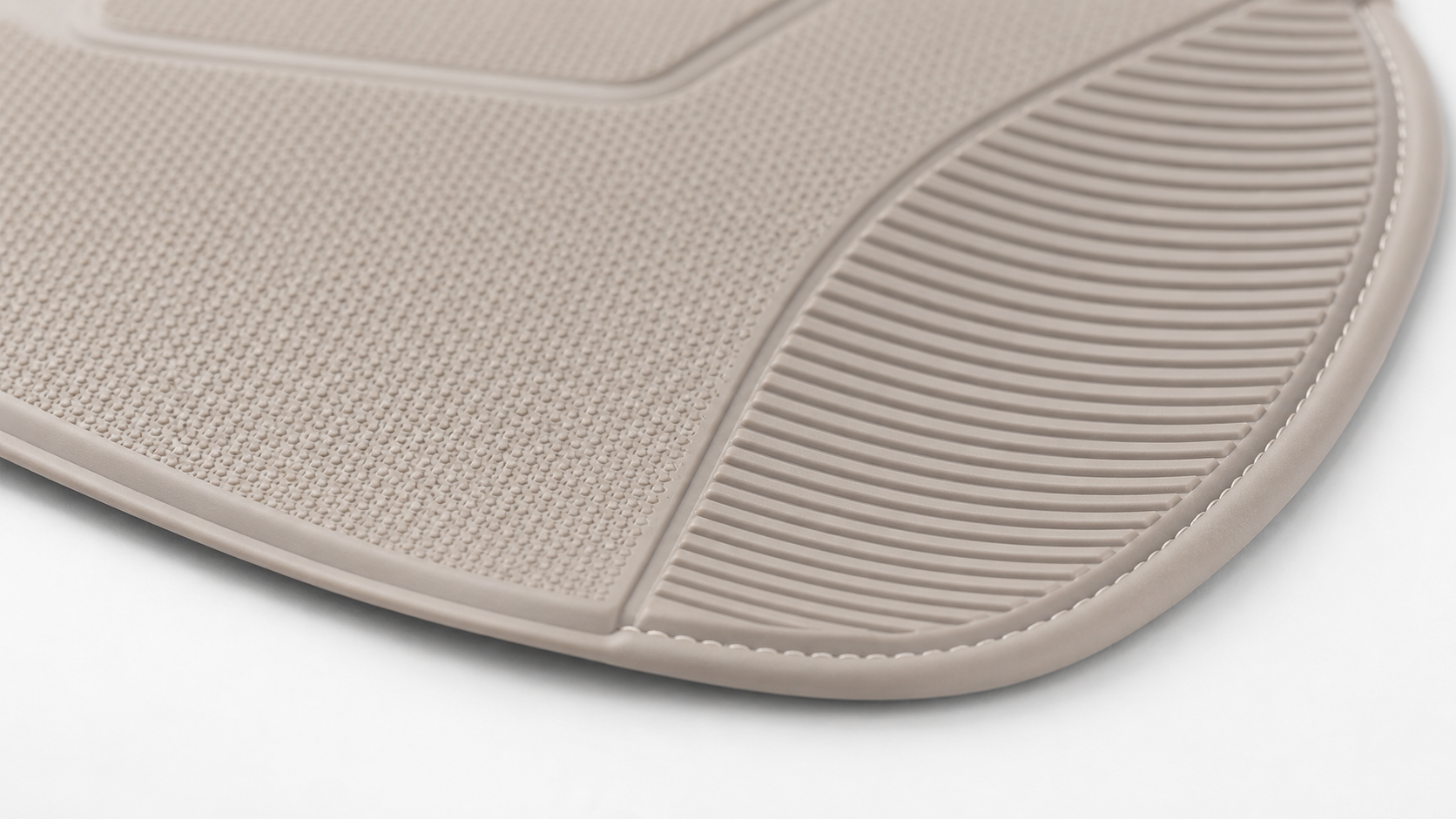
Lab checks are important, but riding checks are just as important. A saddle pad must be tested with the horses and riders that match your target market. A riding school pad should be tested through repeated use on different horses. A competition pad should be tested during harder movement, jumping, transport, and fast cleaning between rounds. A cold-climate pad should be tested in lower temperatures. Silicon Chain states that its silicone tack can stay stable from -30°C to 260°C, which supports use from northern winter barns to hot summer events.
For field testing, create a simple test sheet. Record horse size, saddle type, girth tension, ride time, movement type, sweat level, slipping, rubbing, drying time, and user comments. Use photos before and after the ride. Ask riders if the pad changed their saddle feel. Ask grooms how long cleaning took. These notes are useful for product changes and marketing claims. They also help your sales team explain why the pad costs what it costs.
Competition buyers should also understand venue checks. The FEI regulations page is a useful official source for international equestrian rule references. Silicon Chain can provide compliance material packages for venue checks, including REACH, FDA, LFGB, and ISO-related documents where needed. This does not replace a buyer’s own rule review, but it helps brands prepare better technical files.
Buying Criteria for European Equestrian Brands and Distributors
European buyers often need more than a good sample. They need stable supply, clear documents, market-ready packaging, and fast answers. A strong silicone saddle pad supplier should help with design, compliance, price planning, and delivery. Ask if the factory can support low MOQ trial orders, wholesale pricing, private label packaging, and EU delivery options. Silicon Chain serves tack retailers, EU distributors, riding schools, clubs, and brands that need OEM or ODM production.
Buyers should ask for quote details that reduce hidden risk. A useful RFQ reply should include BOM details, MOQ, lead time, Incoterms, packaging, tooling cost if needed, and document support. Silicon Chain can usually respond to inquiries within 24-48 hours, depending on the project type. For larger custom projects, it can provide a detailed quote within 5 working days. During mass production, photo and video updates can be shared every 5 days.
Delivery planning also matters. Silicon Chain can support delivery to a buyer’s warehouse or through a Rotterdam partner option for European inventory needs. Some programs can also include retail display kits, POS copy, barn-tier pricing, and regional rights. For quality standards, ISO 9001 information from the International Organization for Standardization can help buyers understand the value of a documented quality management system.
Cost, MOQ, and Lead Time Planning for Silicone Saddle Pad Projects
Cost is not only the unit price. A low unit price can become expensive if the pad causes returns, fit complaints, or slow cleaning for end users. Buyers should compare total value. This includes sample cost, tooling, packaging, testing, document support, inspection level, shipping, and after-sales help. Silicon Chain positions itself as a wholesale factory. This means buyers can work directly with manufacturing and engineering teams instead of only trading layers.
For small retail tests, private label is usually the easiest path. The MOQ can start from 250 pieces per SKU for private label projects, and some retail-ready best-selling SKUs may support even smaller mixed orders. For OEM, the MOQ is usually 500 pieces per SKU. For ODM, the MOQ is usually 1,000 pieces per SKU. Large orders can gain better pricing because the factory can plan material, labor, and machine time more efficiently.
Lead time should match your sales calendar. If you need a quick launch before the riding season, private label may fit best. If you want a special silicone saddle pad with custom grip, foam, sewing, and branding, plan more time for sample review and changes. Silicon Chain’s broader private label manufacturing service is introduced on its about us page, where buyers can learn more about factory scale, production capacity, and silicone manufacturing background.
Frequently Asked Questions
How long does it take to sample a custom silicone saddle pad?
For OEM projects, Silicon Chain lists a typical sample time of 15-25 days. For ODM projects, sample development usually takes 25-40 days. Private label projects are faster because they use existing proven products. These can often move from selection to branded launch in about 30 days. The exact time depends on design details, mold needs, packaging, and sample feedback.
What MOQ should I expect for OEM, ODM, or private label horse tack?
The MOQ depends on the cooperation model. Silicon Chain lists private label MOQ at 250 pieces per SKU. OEM MOQ is 500 pieces per SKU. ODM MOQ is 1,000 pieces per SKU. Private label is best for quick market testing. OEM is best when the buyer already has a design. ODM is best when the buyer wants to develop a new product line with the factory.
How do manufacturers control quality in custom silicone horse tack production?
Silicon Chain uses a documented quality process. The team checks design, material, surface treatment, structure, process, and drawings before production. During processing, quality control staff can inspect parts every 2 hours. Before shipment, inspections can cover quantity, key dimensions, tolerance, thickness, depth, appearance, and packaging. Mass production uses AQL 1.5 inspection, with reports and compliance documents available for projects.
What compliance documents can support silicone saddle pad sourcing for Europe?
Silicon Chain can support compliance document packages that include REACH, FDA, LFGB, ISO 9001, and related material or inspection records based on project needs. It can also provide engineering specifications such as silicone grade, Shore hardness, and tensile strength. These documents help European distributors, retailers, and brand teams prepare product files, dealer reviews, and venue checks.
Conclusion: Fit Comes First, Then Factory Capability
Learning how to fit a saddle pad is the first step toward building a better product. The pad must clear the withers, cover the saddle panels, stay stable, clean fast, and protect the horse during real riding. For brands, the next step is choosing a supplier that can turn these fit needs into repeatable production.
Silicone saddle pads offer strong value for modern equestrian buyers. They are easy to rinse, resistant to sweat and odor, stable in wide temperatures, and suitable for daily riding, riding schools, clubs, and competition use. Silicon Chain supports OEM, ODM, and private label silicone horse tack with integrated molding, injection, extrusion, foaming, and sewing capabilities.
If you are planning a new saddle pad range, start with a clear fit checklist and a practical RFQ. Then ask for material data, samples, inspection standards, and compliance documents. To discuss a custom silicone saddle pad project, visit the Silicon Chain website or review its OEM and ODM service options.