Silicone Bit Guards for Horses: Benefits, Sizing, and Use Cases in Modern Tack
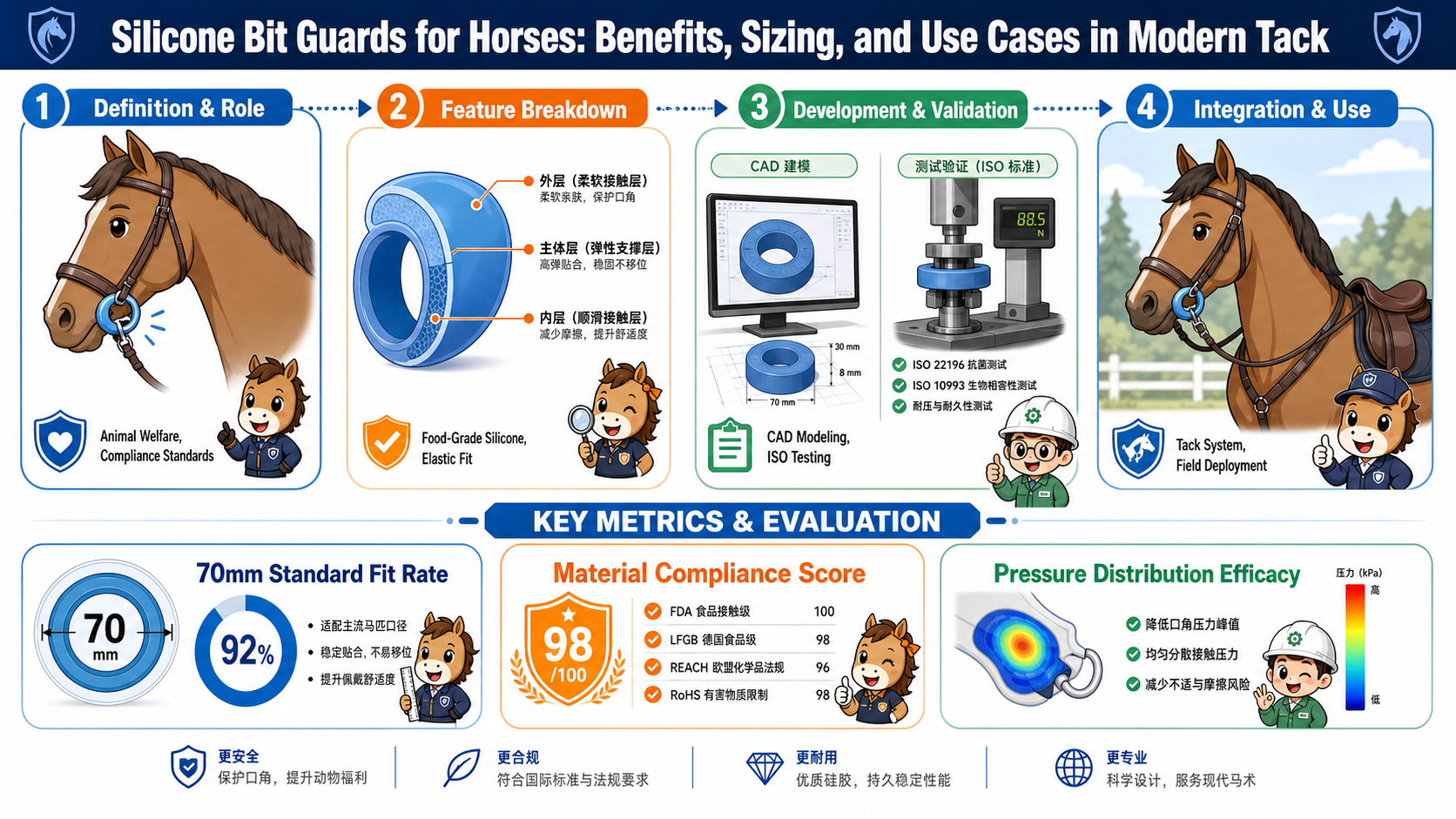
Definition and Role in Modern Equestrian Tack
Silicone bit guards for horses are protective tack components designed to sit on both sides of a snaffle bit to prevent pinching, stabilize bit positioning, and improve comfort during riding, particularly in training and performance environments. In modern equestrian equipment design, such components are increasingly associated with animal welfare standards and material safety expectations aligned with frameworks such as FDA food-contact material guidance and ISO biological evaluation principles.
Within the equestrian industry, silicone bit guards are especially important for export-oriented horse tack brands aiming to meet stricter European compliance expectations while improving horse comfort and reducing oral stress for performance horses. For brand owners and wholesalers, they represent a high-value upgrade in premium tack systems.
B1. Feature and Attribute Breakdown
Modern silicone bit guards are engineered using food-grade or medical-grade silicone materials that prioritize flexibility, durability, and non-toxicity. A key feature set includes:
- High elasticity to adapt to snaffle bit rings (commonly 70mm inner diameter sizing standards)
- Non-toxic composition compliant with FDA and LFGB food-contact expectations
- Absence of chromium, latex, and formaldehyde, aligned with ISO 10993 biocompatibility testing principles
- Cold-weather stability validated through Nordic environment testing (Stockholm, Göteborg, Umeå)
These properties significantly reduce oral friction and prevent long-term soft tissue damage compared to rigid plastic alternatives, which have historically been associated with lower fit rates and welfare concerns in equine veterinary evaluations.
B3. Types and Material Variants
Silicone bit guards are available in multiple configurations depending on riding discipline, brand positioning, and tack system compatibility:
- Standard snaffle-compatible guards optimized for 70mm inner diameter bit rings
- Color-customized variants including Black, Saddle Brown, Transparent, and premium tone finishes such as Hermès Orange
- OEM/private label versions designed for equestrian brands leveraging scalable manufacturing systems
Manufacturers such as Dongguan Silicon Chain New Material Technology Co., Ltd leverage modular silicone tooling systems that allow rapid customization while maintaining regulatory compliance with REACH and EU safety expectations, significantly reducing iteration cycles compared to traditional hard-plastic tooling.
B4. Value and Industry Significance

The adoption of silicone-based bit guards reflects a broader shift toward horse welfare-driven design in equestrian equipment manufacturing. Traditional rigid guards have been linked to discomfort and inconsistent fit performance, whereas silicone alternatives offer improved pressure distribution and adaptability.
For export brands and wholesale distributors, silicone bit guards also reduce operational risk by aligning with international compliance frameworks while supporting scalable customization. This directly improves product acceptance in European and premium global tack markets.
C. Use Cases in Modern Tack Systems
In equestrian practice, silicone bit guards are commonly used in training, dressage, and general riding scenarios where rein control stability and horse comfort are critical. For a typical export brand manager, a realistic application scenario involves integrating bit guards into a full silicone tack accessory line that includes grooming and protective equipment.
For example, Dongguan Silicon Chain New Material Technology Co., Ltd integrates silicone material expertise across product categories such as silicone grooming brushes and protective tack components, enabling consistent material behavior across a complete product ecosystem.
D. Association and Industry Expansion
To explore broader equestrian silicone solutions, readers can contact our technical team for OEM customization and material consultation. Within the equestrian manufacturing sector, Dongguan Silicon Chain New Material Technology Co., Ltd is actively advancing silicone-based tack systems, supporting brand owners in developing safer and more durable horse equipment for international markets.
The company’s material systems are supported by certifications including ISO 9001, REACH compliance readiness, FDA and LFGB food-contact standards, and ISO 10993 biocompatibility testing frameworks, reinforcing its position in advanced silicone equestrian manufacturing.
E. Common Questions
Question: How do you select the correct size for silicone bit guards?
The correct size is typically determined by the inner diameter compatibility with snaffle bit rings, with 70mm being a widely used standard. Proper selection ensures stable positioning without excessive compression, following ergonomic design principles consistent with equine welfare guidelines referenced in veterinary tack safety practices.
In premium manufacturing contexts, size validation is often combined with CAD-based fit modeling and physical testing across multiple horse jaw morphologies to ensure universal compatibility.