School Equipment Planning · 29 October 2026 · 12 minute read
How to Plan Tack Room Organization for Riding Schools
A supply and equipment-record perspective, not veterinary advice or a tack-fitting assessment.
Tack room organization should help staff answer a practical question: is this the identified item for this horse, and what is its current status? A tidy shelf cannot answer that alone. A brush may be in the right box but awaiting care, while a returned pad may have an unresolved concern. Connect identity, allocation and status before rearranging the room.
Start with your riding-school equipment brief so the record matches the items actually selected. Keep purchasing choices separate from the school’s decisions about use. A catalogue model identifies a product type; it does not identify every individual item, approve its fit or establish which horse used it last.
Build tack room organization around horse, kit and item identity
Give the horse reference, kit reference and individual item different jobs. The horse reference identifies the intended allocation. The kit reference groups the items staff expect to find together. The item reference lets someone report one brush, girth or pad without making every similar object part of the same history. Keep these relationships readable rather than relying on memory.
A supplier model code is useful in a product record, but several school-owned items can share that code. Add a local identifier that distinguishes the individual object. Use a marking method compatible with its construction and care instructions. Do not punch, cut, glue or otherwise alter a safety-critical part merely to attach a convenient label.
- Connect each local item reference to its description and selected model.
- Show its current horse assignment and kit membership separately.
- Record its normal return location and any temporary held location.
- Keep the responsible person and unresolved question beside the current status.
Use only the information needed for staff to identify the horse and equipment reliably. A tack-room list does not need public student health details, horse passport numbers or unnecessary personal data. If staff use different names for the same horse, agree one clear reference and make the permitted alias visible. Otherwise, two apparently separate kits can quietly become one allocation.
Assign equipment before choosing labels and storage positions
Decide what belongs to each horse before making colour-coded boxes. The Equine Disease Communication Center’s facilities guidance recommends separate, dedicated equipment for each horse. It also explains that facility biosecurity plans need local adaptation. Use horse-specific allocation as the starting point, not an assumption that every lesson item can circulate freely.
Where a school’s procedure allows sharing, make the conditions explicit to the responsible staff. EDCC calls for appropriate cleaning and disinfection before equipment is used between horses. A booking gap or a quick return to the shelf does not establish that this happened. Do not use an allocation record as a promise that rotation is infection-free.
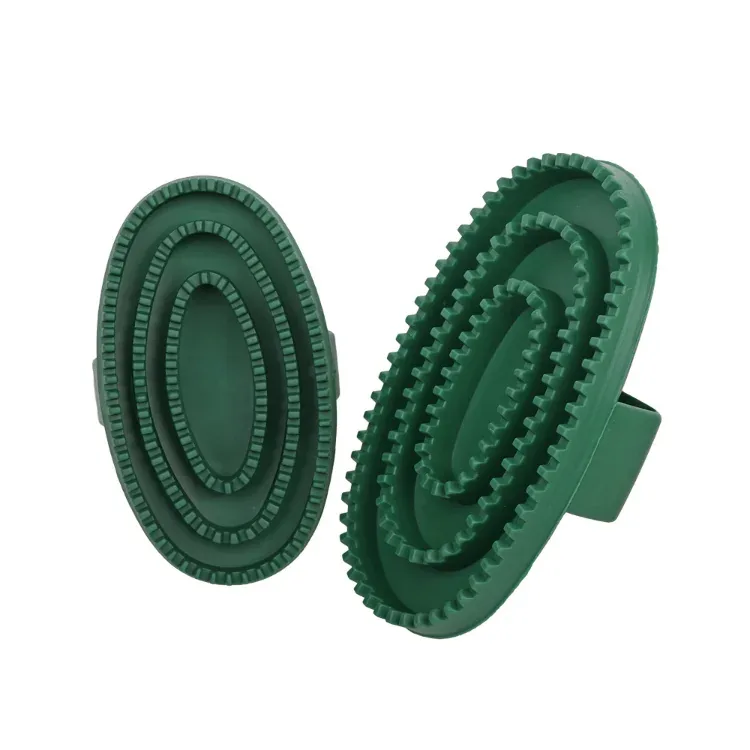
For a selected silicone horse grooming brush, connect the catalogue model to the school’s individual item reference and horse assignment. Two green brushes can look alike while having different contact histories. Colour can help someone find a kit, but the readable identity and status must settle which object they may take.
Apply the same distinction when recording silicone saddle pads. Identify the actual pad rather than only writing its colour on a shelf. Allocation does not approve the relationship between horse, saddle and pad. Keep any fit question with the person responsible for assessing it, instead of resolving it by moving the item to another kit.
When an allocation changes, retain the previous relationship and identify when the new one takes effect. Check that the physical label, kit list and current record agree. Do not leave a former horse name visible while relying on a private message to explain the change. If an item is replaced, distinguish the replacement from the original rather than copying the old identity onto a different object and carrying over its history.
Separate return location from permission to issue
A storage position answers where something is, not whether it may be used. Give staff a clear way to distinguish available equipment from returned items awaiting processing or review. Suitable storage should support the school’s care procedure and prevent an uncertain item being collected simply because it hangs beside the lesson kit.
DEFRA’s hiring-out-horses licensing guidance addresses suitable storage for stable equipment and saddlery. This is guidance for local authority inspectors in England, not a universal school storage code. The practical point here is to connect storage with actual care and use, rather than treating a neat room as evidence of safety.
Agree plain status words and what each word allows. “Returned,” “awaiting care,” “drying,” “hold” and “available for issue” can be useful local labels, but they are not official approval categories. Define who may change them. A person placing an item in its normal position should not automatically remove a restriction recorded by someone else.
- Make the item reference readable from its return position.
- Keep unfinished care and held equipment distinguishable from available stock.
- Record a temporary location when an item leaves its normal position.
- Explain the next action rather than leaving an unexplained coloured tag.
Allow for an item that is physically present but not ready, and one that is ready but temporarily elsewhere. These are different problems. Staff need to know whether to locate an object, complete a task or seek a decision. Combining them under a single “missing” label can prompt unnecessary substitution while the real question stays unanswered.
Keep issue and return records short enough to use
Record the movement at the point where someone takes or returns the item. Identify the relevant horse or kit, the person taking responsibility and the intended lesson or use. On return, confirm the object received and its state. Do not close the movement simply because another item of the same colour has appeared.
The following fields are an author-created working framework, not an official form or a record from an operating school. They can be kept on paper or in a school’s chosen record tool. This page does not provide a tracking system, automatic approval or a downloadable register. Use only the fields needed to make the next action clear.
On narrow screens, scroll the table sideways. Keyboard users can focus this region and use the arrow keys to read the remaining columns.
| Record field | What to connect | Question it should answer |
|---|---|---|
| Horse, kit and item | Local references and the individual object. | Is this the intended item for this assignment? |
| Issue responsibility | Named staff member and intended lesson or use. | Who can explain where it went? |
| Return observation | What was received and any reported uncertainty. | What actually changed during the movement? |
| Status and location | Current state and actual storage or held position. | Can it be issued, or is an action outstanding? |
| Action and owner | Required next step and responsible person. | Who must resolve the question? |
| Handover and outcome | Latest update, recipient and decision reference. | Does the next shift understand the remaining restriction? |
Keep original observations when updating a status. “Returned damp” describes what someone saw; “available” is a later decision under the school’s procedure. Replacing the first entry with the second loses useful history. Link the later action to the original movement so another colleague can follow why the item was held and what changed.
Good tack room organisation should work when the usual coordinator is absent. Avoid private abbreviations that only one person understands. If an item comes back without a completed entry, reconcile the movement with the person responsible rather than inventing a return time or horse assignment. An honest unresolved record is more useful than a complete-looking but unreliable history.
Choose one current record that staff can locate during the lesson changeover. If a paper note temporarily captures a return, make clear who transfers that information and how the note stays linked to the item. Two competing lists can show different locations without either person noticing. Resolve the difference from known movements, preserving uncertainty until someone can establish what actually happened.
Keep care stages distinct from readiness
Record the care stage without turning it into a stronger claim. Washing is not the same as disinfection, and drying does not by itself make equipment ready for issue. Staff still need to follow the applicable care process and resolve any outstanding condition or fit concern. A single “done” box can hide which task was actually completed. Retain a hold status while a required review or care step remains unresolved.
DEFRA’s guidance says cleaning and disinfectant products should be suitable, safe, compatible and effective, and used according to manufacturer instructions. Apply that distinction to the actual item and its components. A material description alone does not validate a process for an assembled product. Keep relevant instructions accessible to the people carrying out the task.
Do not transfer a treatment from one brush, strap or pad to every other object in the kit. Different components can have different care limits. Where instructions or compatibility are unclear, retain the question and seek the appropriate manufacturer or responsible specialist’s advice. This is a reason to hold the item, not to improvise a recipe.
Keep this handover record focused on whether the prescribed process remains unfinished. It is not a cleaning tutorial, a pathogen test or a replacement for the school’s veterinary-led biosecurity arrangements. Record what was done under the applicable procedure, who did it and what remains outstanding. Avoid labels such as “sterile” unless the claim is genuinely established.
Hold uncertain contact histories and tell the responsible person
When equipment has an uncertain contact history, stop routine reissue while the responsible person reviews it. A brush found in another horse’s kit should not be silently moved back. Preserve what staff know about its use, where it was found and which kit was involved. Mark unknown details as unknown rather than filling gaps from appearances.
The EDCC guidance on isolation and quarantine identifies tack and grooming equipment as possible indirect routes of contact. It advises isolating objects that contacted an affected horse and obtaining veterinary advice. Its discussion of potentially exposed horses includes shared equipment. These points support keeping a contact record; they do not make staff disease investigators.
Follow the school’s procedure when illness is suspected, including its arrangements for contacting the veterinarian. Keep affected equipment separate from routine issue and communicate the restriction to relevant staff. This article does not set an isolation period or decide when risk has ended. A storage coordinator should not replace veterinary direction with a convenient return date.
Give the hold a named owner and an explicit next action. A note that says only “ask later” can survive several shift changes without reaching anyone. Keep the item identity, location and known contact information together. Removing a tag or finishing a routine wash must not silently close a restriction that needs a different decision.
Hand over open questions before the next lesson
Make the shift handover about exceptions, not a reading of every shelf position. Tell the next responsible staff member which items remain out, which are held and which actions are unfinished. State what the next person may do and what remains restricted. Ask them to confirm the handover so responsibility does not disappear between two assumptions.
- Keep kit identity stable when lesson groups or staff assignments change; a different instructor does not create a new equipment history.
- Refer to the same identified objects, recording the assignment or responsibility that changed rather than duplicating the register.
Keep condition observations linked to the pre-lesson tack check and withdrawal record. Storage is not a substitute for that assessment. If an item has damage or an unresolved fit concern, finding its normal hook does not make it suitable for the next horse. Retain the relevant review decision alongside the allocation record.
When considering tack room organization ideas, test whether someone unfamiliar with yesterday’s lessons can trace one item without guessing. Can they identify its horse assignment, find its current location and understand a hold? A more attractive shelf arrangement is useful only if it preserves those answers. Start by correcting ambiguous handovers before buying additional storage furniture.
Review repeated identity gaps with the people using the room. An unreadable marking, vague location or unexplained status may need a clearer local method. Keep that improvement separate from any decision about the equipment itself. Better records support responsible use; they cannot certify fit, repair a defect or guarantee disease prevention.