Custom Manufacturing & Sourcing · 31 October 2026 · 12 minute read
OEM vs ODM Manufacturing: Choosing a Custom Horse Tack Route
Source-compiled manufacturing pathway and project-scoping notes from a Product Manager. Not legal counsel, regulatory certification or a fixed commercial quotation.
Evaluating oem vs odm manufacturing is one of the earliest structural decisions an equestrian brand, distributor or product developer makes when bringing silicone and composite horse tack to market. Unlike single-material plastic accessories, functional horse equipment combines compression-moulded or liquid-silicone-injected contact zones with shock-absorbing foam cores, breathable bamboo-charcoal or polyester meshes, synthetic microfibre or genuine leather straps, and 304 or 316 stainless steel hardware. Selecting the wrong manufacturing route can either lock capital into bespoke steel cavities before rider demand is proven, or leave a distinctive product concept without clear cavity exclusivity.
This guide explains how engineering inputs, mould investment, intellectual property boundaries and regulatory documentation differ across catalog adaptation, ODM co-development and full OEM bespoke tooling. You can review our custom horse tack OEM and ODM services to see how our Dongguan facility integrates five core processes under one roof and prepares written quotations per project brief.
1. Define the operational difference between OEM and ODM in horse tack
Across industrial supply chains, buyers frequently ask about the practical difference between oem and odm when scoping a new product line. In equestrian manufacturing, the distinction centers on who creates the part geometry, selects the material stack and validates the tooling parameters before steel cutting begins.
In an Original Equipment Manufacturing (OEM) project, the purchasing brand acts as the primary product architect. Your team supplies complete 3D CAD assemblies (STEP or IGES), 2D tolerance drawings, target Shore A durometer callouts, textile or leather backing specifications, and hardware grades. Our Dongguan engineering team reviews those files for manufacturability, builds dedicated compression or injection moulds to your geometry, and manufactures the product strictly to your drawing package.
When comparing odm vs oem for a multi-layered saddle pad, contoured girth or overmolded bit, Original Design Manufacturing (ODM) shifts structural co-development to the factory. You provide a functional brief—such as spine-relief dimensions, target rider discipline, grip density or anatomical elbow clearance—and our in-house team develops the 3D profile, silicone foam density, fabric lamination and mould design. A third, lower-threshold route uses existing moulds from our 15 registered catalogue models for private-label colour, hardness, logo and packaging customization without new cavity machining.
- Catalogue adaptation (existing moulds): Best when launching a seasonal collection or testing a new retail channel using proven geometry with custom colours, embossed logos and branded packaging.
- ODM co-development: Best when your brand wants a differentiated grip pattern, modified contour or custom composite stack without maintaining an internal elastomer and tooling engineering department.
- Bespoke OEM manufacturing: Best when your team holds proprietary 3D CAD geometry, patented hardware interfaces or strict anatomical dimensions that require exclusive custom cavities from day one.
2. Match your product architecture to our five in-house Dongguan processes
Whether you choose an OEM or ODM pathway, every silicone horse tack item must be engineered around the physical behaviour of cross-linked elastomers and the secondary materials joined to them. At our roughly 7,000 m² facility in Dongkeng Town, Dongguan, five in-house workshops handle solid silicone compression molding, liquid silicone rubber (LSR) injection and overmolding, silicone extrusion, silicone foam processing, and multi-material sewing and hardware assembly.
As Protolabs explains in its engineering guide on designing for liquid silicone rubber, LSR is a two-part thermoset compound cured inside a heated mould; once cross-linked, its moulded state is permanent and cannot be re-melted like a thermoplastic. Because LSR flows easily into thin walls and gaps as small as 0.0002 in., parting lines must be simplified and kept away from sensitive equine skin or mouth contact zones, while internal corners need generous fillets or radii to prevent tearing during demolding.
When a product requires rigid structural strength—such as a 304 stainless steel mouthpiece core inside an SC-SMMB-01 bit or an aluminium tread inside an SC-SSC-01 stirrup cover—insert molding loads a preformed metal part into the cavity before overmolding. Both the insert molding engineering guide and LSR design guidelines note that silicone generally does not chemically bond to metal without dedicated primers or surface treatments.
Consequently, engineers design mechanical bonding features (undercuts, through-holes or knurled shoulders) into the metal core to lock the elastomer sleeve permanently in place. For anatomical girths such as our Silicone Leather Girth (Flagship Model), solid compression-moulded silicone channels are paired with high-tensile synthetic microfibre backing and 316 stainless steel roller buckles in our sewing and assembly line.
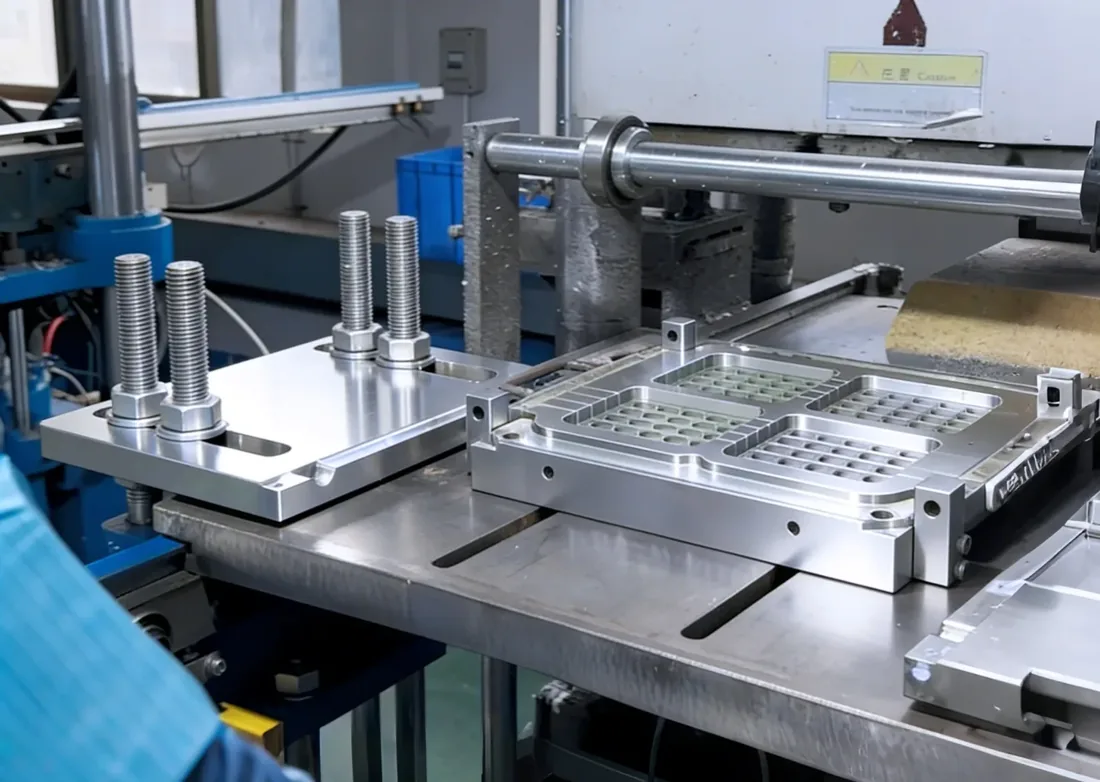
3. Compare engineering inputs, tooling ownership and commercial terms
Before signing a development agreement, commercial and technical buyers should align internal expectations on four project variables: design input depth, mould investment, tooling ownership and minimum order structure. Rather than relying on generic online calculators or unverified fixed-day guarantees, evaluate how each route allocates responsibility between your brand and the factory.
For example, adapting an item from our silicone girth category using existing moulds avoids new steel-cutting lead time, allowing your team to focus on Shore A durometer selection (typically 30 to 70 Shore A as outlined in liquid silicone rubber injection molding capabilities), Pantone colour matching across silicone and synthetic leather substrates, and buckle laser engraving. Conversely, commissioning a bespoke OEM saddle pad grip array or overmolded bit mouthpiece requires upfront DFM analysis, CNC/EDM mould machining, T1 trial shots and written agreement on cavity exclusivity.
On narrow screens, scroll this table sideways. Keyboard users can focus the region and use the arrow keys to inspect every column.
| Decision dimension | Catalogue adaptation (existing moulds) | ODM co-development | Bespoke OEM manufacturing |
|---|---|---|---|
| 1. Buyer technical input | Target SKU, colour callouts, logo vector files & packaging artwork | Functional brief, anatomical target, grip/foam concept & reference samples | Complete 3D CAD (STEP/IGES), 2D tolerance drawings & itemised multi-material BOM |
| 2. Factory engineering role | Compound pigment matching, logo plate/embossing setup & assembly QC | Co-design 3D profile, foam density, backing stack, DFM & new/modified tooling | DFM review on parting lines/inserts, precision mould build & build-to-print execution |
| 3. Tooling ownership & exclusivity | Base cavities remain factory standard; custom logo inserts held for your brand | Defined in written contract (shared tooling vs buyer-funded exclusive cavities) | Buyer-funded custom mould cavities with written exclusivity & custody terms |
| 4. Sampling & pilot batch gate | Colour/logo pre-production sample sign-off before batch assembly | 3D prototype check, T1 trial moulding, rider fit feedback & pilot batch sign-off | Formal First Article Inspection (FAI), dimensional/durometer report & pilot batch release |
| 5. Regulatory & technical file scope | Factory BOM, material declarations & batch labels compiled for buyer's brand file | Updated design drawings, composite BOM & risk records for modified construction | Full drawing revision log, FAI metrics, material traceability & GPSR technical file pack |
4. Clarify regulatory duties and technical files for EU and UK own-brand buyers
A critical point often overlooked when comparing OEM and ODM contracts is legal product responsibility in destination markets. Whether a product is manufactured from your OEM CAD drawing, co-developed via ODM, or rebranded from an existing factory mould, selling horse tack under your own trademark in Europe or the United Kingdom carries specific statutory duties.
According to UK Office for Product Safety and Standards guidance on product safety advice for businesses, the General Product Safety Regulations 2005 and Regulation (EU) 2023/988 on general product safety (applicable in the EU and Northern Ireland from 13 December 2024) require businesses to minimise product risks, generate and keep associated technical documentation, place appropriate traceability labelling on the product, and provide clear safety instructions.
Furthermore, UK Department for Business and Trade guidance on placing products on the market under your own name or trademark states that an importer or distributor who markets a product under its own name or trademark—or modifies a product in a way that affects compliance—assumes the legal responsibilities of the manufacturer and must hold sufficient design and production information in a technical file (typically retained for 10 years).
Similarly, guidance on placing manufactured products on the market in Great Britain clarifies two vital distinctions for OEM/ODM projects: first, components imported for further manufacture or assembly are not yet considered placed on the market until the finished assembly is released, and second, prototypes displayed under controlled conditions at trade fairs or pre-production units undergoing validation are distinct from finished goods released for consumer testing. Structuring your OEM or ODM contract so that drawing revisions, bill-of-materials tables, compound declarations and batch numbers flow cleanly into your brand's technical file prevents compliance bottlenecks before launch.
5. Stage your investment from existing moulds to pilot batch validation
Many successful equestrian brands do not treat catalogue customization, ODM and OEM as mutually exclusive choices. Instead, they sequence them across product categories to manage cash flow and engineering lead times while gathering real stable feedback.
- Phase 1 — Validate channel demand on existing moulds: Select proven items (such as grooming brushes, stirrup covers or standard contoured girths), specify your brand colours and logo placement, and confirm retail packaging and batch traceability labels.
- Phase 2 — Lock DFM and tooling terms for ODM or OEM hero items: Submit your functional brief or 3D CAD for high-differentiation items, review parting-line placement and mechanical insert retention, and sign a written tooling agreement defining tooling ownership, cavity count and maintenance responsibilities.
- Phase 3 — Approve T1 samples and run a controlled pilot batch: Inspect first-off moulded parts for Shore A hardness, flash-free contact edges and stitching tension, validate assembly consistency through a pilot batch, and archive the approved Golden Sample and technical file before scaling mass production.
An illustrative equine project pathway review (Project Brief OEM-304)
This example is clearly fictional and provided solely to show how a buyer structures a multi-sku custom inquiry; it is not a client case study, guaranteed lead-time promise or fixed pricing schedule. In fictional Project Brief OEM-304, Product Director K at a northern European equestrian brand prepares a three-item autumn development plan with our Dongguan engineering team.
For Item A (an easy-clean anatomical girth), K chooses catalogue adaptation using the existing moulds of SC-SG-01. Rather than funding new mould steel, K specifies a forest-green synthetic microfibre backing, a 50 Shore A black silicone contact channel, custom laser-etched 316 stainless steel roller buckles, and a woven size and batch label so the brand can test retail sell-through first.
For Item B (a high-wither dressage pad), K selects an ODM co-development route based on SC-SSP-01. K supplies wither-clearance measurements and requests a modified hexagonal silicone grip layout paired with a perforated shock-absorbing silicone foam core and bamboo-charcoal mesh lining. Both teams agree in writing that the new grip-plate compression mould is funded by the buyer, with exclusive cavity use reserved for K's brand.
For Item C (a proprietary anatomical poll and noseband cushion insert), K's industrial designer supplies full 3D STEP files for bespoke OEM manufacturing. During DFM review, our engineers recommend shifting the mould parting line 1.8 mm away from the lower cheek edge, increasing internal corner radii to prevent demolding tears, and scheduling a 200-piece pilot batch after T1 sample sign-off. In the contract annex, K specifies the exact drawing revision numbers, bill-of-materials sheet and batch-code format required for the brand's EU/UK GPSR technical file.
6. Avoid common scoping pitfalls in custom silicone tack projects
Delays in custom horse tack development rarely happen during hydraulic press curing itself; they almost always trace back to ambiguous handoffs between industrial design, purchasing and the mould shop. Watch for three recurring mistakes when scoping an OEM or ODM programme.
First, do not assume that raw silicone compound properties or automotive/medical material test reports automatically certify a finished composite bridle, girth or saddle pad. A complete tack item includes fabrics, foams, threads, adhesives and metal buckles; your specification and technical file must account for every layer in the finished assembly. Second, never leave tooling ownership, cavity count or mould storage duration unwritten when paying for custom cavities. Third, avoid skipping from a single hand-trimmed prototype straight into a large commercial order without verifying multi-material sewing alignment and packaging fit on a pilot batch.
7. Prepare your project brief and transition to DFM & First Article checks
Once your team decides which products will use existing moulds, which will follow ODM co-development, and which require bespoke OEM tooling, the next step is translating those choices into verifiable engineering documents. Clear drawings and inspection criteria allow our Dongguan team to quote tooling and unit costs accurately without guesswork.
Continue to our companion guide on preparing silicone injection molding drawings and first article inspection checks to review elastomeric tolerance rules (`+/- 0.025 in./in.`), metal insert retention features and FAI sign-off checklists. When you are ready to discuss your project, email your 2D/3D files or functional brief, target quantities per SKU and destination market requirements so our engineering and sales team can prepare a written proposal.